Volume 9, Issue 4 (Journal of Clinical and Basic Research (JCBR) 2025)
jcbr 2025, 9(4): 27-31 |
Back to browse issues page



Download citation:
BibTeX | RIS | EndNote | Medlars | ProCite | Reference Manager | RefWorks
Send citation to:


BibTeX | RIS | EndNote | Medlars | ProCite | Reference Manager | RefWorks
Send citation to:
Jannesari F, Yazdi K, Ghorbani S, Kolagari S. Relationship between medication safety competence and selected demographic and professional characteristics among critical care nurses in northeastern Iran in 2024. jcbr 2025; 9 (4) :27-31
URL: http://jcbr.goums.ac.ir/article-1-537-en.html
URL: http://jcbr.goums.ac.ir/article-1-537-en.html


1- Department of Critical Care and Medical-Surgical Nursing, School of Nursing and Midwifery, Golestan University of Medical Sciences, Gorgan, Iran
2- Nursing Research Center, Golestan University of Medical Sciences, Gorgan, Iran
3- Department of Biostatistics and Epidemiology, School of Health, Golestan University of Medical Sciences, Gorgan, Iran
4- Nursing Research Center, Golestan University of Medical Sciences, Gorgan, Iran ,kolagari4@gmail.com
2- Nursing Research Center, Golestan University of Medical Sciences, Gorgan, Iran
3- Department of Biostatistics and Epidemiology, School of Health, Golestan University of Medical Sciences, Gorgan, Iran
4- Nursing Research Center, Golestan University of Medical Sciences, Gorgan, Iran ,
Keywords: Critical care, Nurses, Medication safety competence, Demographic characteristics, Professional characteristics
Full-Text [PDF 491 kb]
(275 Downloads)
| Abstract (HTML) (1055 Views)
The demographic questionnaire, developed by the research team, included variables such as age, gender, marital status, and education level. Professional characteristics included employment status, clinical nursing experience, critical care nursing experience, and type of shift.
Medication Safety Competence Scale (MSCS)
This scale was developed by Park et al. (2021) in South Korea (12), and translated and psychometrically validated in Persian by Mohammadi et al. in 2023, with an overall Cronbach’s alpha coefficient of 0.96 and 0.77 to 0.91 for its subscales/dimensions (13). The instrument included 36 items across six subscales: patient-centered medication management (9 items), safety problem improvement (8 items), management of affecting factors (6 items), safety risk management (6 items), multidisciplinary collaboration (4 items), and responsibility in the nursing profession (3 items). Each item is scored on a 5-point Likert scale: never (1), rarely (2), sometimes (3), often (4), always (5). Total scores range from 36 to 180, with scores of 36-90 indicating poor medication safety competence, 91-150 indicating a moderate level, and 151-180 indicating a high level. The instrument has established psychometric properties, and its reliability in the Iranian context was confirmed by Mahmoud Zadeh et al. (2024), who reported a Cronbach’s alpha coefficient of 0.81 (11). To facilitate comparison among subscales, the raw mean score for each subscale was divided by the number of items in that subscale.
Data collection
Data collection commenced after obtaining ethical approval from the Ethics Committee of Golestan University of Medical Sciences (IR.GOUMS.REC.1403.230). Eligible nurses were identified and invited to participate in the study. After providing a clear explanation of the study objectives, written informed consent was obtained from all participants. Data were collected using self-administered questionnaires, which were distributed in person by the researcher. Questionnaires were completed individually and collected on the same day to ensure data completeness. Data collection was conducted over a four-month period, from October to January 2024. A total of 225 questionnaires were distributed and completed in full. No participant attrition occurred during the data collection process. The researcher visited the selected units during morning, evening, and night shifts to ensure adequate access to participants across different work schedules.
Data analysis
All completed questionnaires were entered into the statistical analysis. Data were analyzed using SPSS version 26. Descriptive statistics, including mean and standard deviation for quantitative variables and frequency and percentage for qualitative variables, were used. The normality of quantitative variables was assessed using histograms, normal distribution curves, and the Kolmogorov-Smirnov test. The results indicated that the data were not normally distributed (p < 0.05). Therefore, the Mann-Whitney U test and Kruskal-Wallis test were used for bivariate analyses. Stepwise multiple linear regression analysis was then performed to identify demographic and professional predictors of medication safety competence. To investigate the effect of demographic and professional variables on the medication safety competency score, the assumptions of the linear regression model were examined, including normality of the distribution, independence of observations and equal variance. Then multiple linear regression was fitted to the data. The significance level for all tests was set at 0.05.
Results
The mean age of the nurses was 32.26 ± 7.40 years, and the median (Range) was 31 years (22-51). Most participants were female (175, 77.8%). The largest age group consisted of nurses younger than 30 years (110, 48.9%). The majority of them (89.3%) had a bachelor's degree. The other demographic and professional characteristics of the participants are presented in Table 2. The mean ± standard deviation of the total medication safety competence score was 137.51 ± 27.81, and the mean scores of its subscales are shown in Table 3. Among the subscales, safety risk management had the highest mean score (3.90 ± 0.96), whereas multidisciplinary collaboration had the lowest mean score (3.59 ± 1.00).
Among the variables examined, medication safety competence was significantly associated with age (p = 0.043) and clinical nursing experience (p = 0.009).
Among the examined variables, a significant association was found between medication safety competence and both age and clinical nursing experience (p=0.043, p=0.009 respectively). Post hoc analysis revealed a significant difference in mean competence scores for nurses aged 42 years or older compared with other age groups (p < 0.014). Similarly, nurses with more than 20 years of clinical nursing experience had significantly higher competence scores than the other experience groups (p < 0.002).
In the stepwise multiple linear regression analysis, only age (p = 0.027) and clinical nursing experience (p = 0.017) remained in the final model, whereas the other variables were excluded because they were not statistically significant. These results indicate that age and clinical nursing experience are significant predictors of medication safety competence. Specifically, each additional year of age was associated with a 0.55-point increase in medication safety competence score, and each additional year of clinical nursing experience was associated with a 0.63-point increase. The variance inflation factor (VIF) was 1.00, indicating no evidence of multicollinearity among the predictors (Table 4).
Discussion
The present study was conducted to examine the association between medication safety competence and selected demographic and professional variables among nurses working in critical care units. According to the findings, nurses demonstrated a moderate level of medication safety competence, with only a small proportion exhibiting poor competence. Similar results were reported in studies by Mohebi (2024), Mahmoud Zadeh (2024), Aghabarary (2025), Aydinli (2024), Song and colleagues (2022), where medication safety competence was also found to be moderate (6,11,14-16). In contrast, studies by Mohammadi (2023) and Zhang et al. (2024) reported high levels of medication safety competence (13,17). Because most studies report moderate to high levels of competence, and very few report poor competence, it may be inferred that nurses generally have an awareness of professional responsibility and demonstrate a basic level of medication safety competence (11).
Among the subscales, safety risk management had the highest mean score, whereas multidisciplinary collaboration had the lowest. Safety risk management reflects the ability to respond promptly and report errors during medication safety incidents and adverse drug events. Multidisciplinary collaboration refers to the ability to work cooperatively, communicate effectively, and share decision-making with other healthcare providers throughout the medication-use process (11). In the study by Mohebi et al. (2024), the highest mean score was reported for the subscale “management of influencing factors,” while the lowest was observed for “responsibility in the nursing profession” (14). Song et al. (2022) similarly reported the highest score for “management of influencing factors” and, consistent with the present findings (16). In the study by Zhang et al. (2024), the highest score corresponded to patient-centered medication management, whereas the lowest pertained to safety problem improvement (17). Aghabarary et al. (2025) also found the highest scores for patient-centered medication management and, similar to our results, the lowest for multidisciplinary collaboration (6). Similarly, Kim et al. reported the highest and lowest scores for patient-centered medication management and multidisciplinary collaboration, respectively (18). In studies by Mohammadi (2023) and Aydinli (2024), the highest means were also observed for patient-centered medication management and the lowest for responsibility in the nursing profession (13,15).
Across many studies, patient-centered medication management consistently receives the highest scores among the dimensions of medication safety competence. This subscale reflects the ability to assess the effectiveness of medication education, document care accurately, plan and administer medications, complete dosage procedures correctly, and evaluate patients’ conditions during medication administration, thereby ensuring safe drug delivery (12). However, in the present study, the highest mean score was observed for safety risk management. This contrast may be attributed to positive factors such as the institution’s emphasis on patient safety and a well-established error-reporting culture, or conversely, to challenges like staffing shortages and workload pressures. It may also depend on the type of clinical unit studied or targeted nursing education related to safety risks. Therefore, differences between the present and previous studies likely originate from organizational, educational, and environmental factors. These findings highlight that various aspects of medication safety competence are influenced by the nursing work environment, and that practical priorities shift depending on healthcare system characteristics and management structures.
Furthermore, low scores in multidisciplinary collaboration observed in several studies may be linked to traditional hospital structures, communication barriers between professional groups, and a lack of interpersonal education or teamwork training (10,19). The higher standard deviation observed for this subscale compared with others indicates greater variability in nurses’ experiences and perceptions. These findings suggest that nurses demonstrate a somewhat passive role in collaborative practice with other healthcare team members. Enhancing interpersonal communication and collaboration is essential for strengthening patient safety and improving safe nursing care (18). Effective teamwork requires the ability to anticipate others’ needs, adapt to changing roles, respond to environmental changes, and maintain a common perception of tasks to achieve optimal outcomes (20).
The results also showed that nurses aged over 42 years had significantly higher medication safety competence scores compared with younger age groups. No significant difference was observed between the two younger groups, suggesting that age becomes influential when nurses enter their early forties. This likely reflects the accumulation of substantial clinical experience and exposure to complex care situations, which ultimately enhances medication safety competence. Similarly, nurses with more than 20 years of work experience had significantly higher competence levels than those with less than 9 years or 10–19 years of experience. This finding indicates that substantial improvements in medication safety competence typically emerge during the third decade of professional practice. Consistent with the present results, studies by Luokkamäki (2021), Jung (2025), and Mahmoud Zadeh et al. (2024) also demonstrated that higher age and longer clinical experience contribute to improved decision-making, clinical reasoning and enhanced medication safety competence (1,11,21).
Conclusion
The present study highlights moderate medication safety competence among nurses. Although a small proportion of nurses demonstrated low competence, the overall mean score suggests that there remains considerable room for improvement. Accordingly, the moderate level observed in this study warrants attention from nursing administrators and healthcare policymakers.
The highest score in safety risk management may reflects the institution’s emphasis on patient safety culture, error reporting, risk management training, and accreditation requirements-particularly in critical care units, where the consequences of medication errors are more severe. Conversely, multidisciplinary collaboration received the lowest score. This weakness is important, as insufficient collaboration is a recognized contributor to medication errors in critical care settings, emphasizing the need for teamwork educational interventions and strengthened nursing involvement in medication-related decision-making.
Only age and clinical nursing experience were significant predictors of medication safety competence. Meaningful improvement in competence appeared primarily after the fourth decade of life and beyond 20 years of clinical experience, highlighting the importance of practical exposure to complex clinical situations, crisis management, and the progressive recognition of error patterns. These findings also underscore the value of experienced nurses in critical care units.
Overall, this study emphasizes the need for organizational investment in enhancing medication safety skills, particularly among younger and less experienced nurses. Future research is recommended to explore strategies for strengthening multidisciplinary collaboration and reducing communication barriers among healthcare providers.
Acknowledgement
This article is part of a master’s thesis in critical care nursing supported by Golestan University of Medical Sciences. The authors express their sincere gratitude to the university’s Vice-Chancellery for Research and Technology and to the dedicated and compassionate nurses who generously assisted despite their workloads.
Funding sources
The Research and Technology Deputy of Golestan University of Medical Sciences financially supported the present study.
Ethical statement
All ethical requirements were observed throughout the study. This study was approved by the Ethics Committee under the code IR.GOUMS.REC.1403/230. Authorization was obtained from the university and participating hospitals; written informed consent was secured from all nurses; confidentiality and anonymity of responses were ensured; and participants were free to enter or withdraw from the study at any stage. The study presented no more than minimal risk of harm to subjects and involved no procedures for which written consent is required outside the research context. The cross-sectional design, reliance on self-reported data and restriction of the sample to critical care nurses in teaching hospitals limit generalizability of the finding.
Conflicts of interest
The authors declare no conflict of interest.
Author contributions
SK and KY Conceptualized the study design, SK and FJ Writing-Review and Editing, Writing-Original draft, Validation, Supervision, Project administration, Methodology, Data curation, and Conceptualization, FJ and SG Analyzed and Interpreted the data, SK and FJ Drafted the manuscript. All authors read the revised manuscript and approved the final version.
Data availability statement
The data support the findings of present study are available from the corresponding author upon reasonable request.
Full-Text: (218 Views)
Introduction
Medication errors cause serious complications to healthcare systems worldwide. The most critical aspect of medication errors is their preventability and the potential for serious patient injury. Medication safety is defined as the absence of preventable harm associated with medication use (1). Safe nursing care is a fundamental component of nursing quality (2) and refers to the application of nurses’ knowledge and skills to deliver high-quality care while minimizing the risk of patient harm. In other words, safe nursing care aims to ensure patient safety across all dimensions of care and is considered a key indicator in clinical governance and risk management programs (3). Safe nursing care has also been described as the prevention of harm that may arise from clinical or medical errors (4).
Drug administration constitutes a complex process involving multiple steps, including diagnosis, drug selection, dose calculation, precise preparation by the nurse, patient education, medication infusion, ongoing monitoring and evaluation by physicians and nurses, and accurate documentation (5). Medication administration is one of the core responsibilities of nurses, and the quality and quantity of these activities directly influence patient safety and the overall quality of care (6). In addition, nurses play a pivotal role in medication safety management that extends beyond drug preparation and administration. They coordinate the care process and, due to their continuous interaction with patients, are uniquely positioned to assess patients’ conditions regarding prescribed medications using their knowledge, critical thinking, and clinical reasoning skills (6,7).
Medication safety refers to protecting patients from potential harm associated with medication use. It includes efforts to prevent the causes of medication errors and to identify, manage, and mitigate adverse drug reactions. Medication safety competence refers to the knowledge, attitudes, and skills related to medication safety (8) that nurses apply in clinical practice. This competence includes theoretical and cognitive knowledge, practical skills, and decision-making abilities. Medication safety competence is demonstrated throughout the medication administration process, which includes assessing the patient’s need for medication, evaluating the patient’s clinical condition, preparing the medication, dispensing and administering it, providing patient education effectively, and monitoring and evaluating its effectiveness. It also involves responsibilities related to medication storage, transport, and safe disposal. Medication safety competence is inherently linked to nurses’ professional values, work-related attitudes, and individual patient circumstances (9).
The importance of medication safety competence is particularly pronounced in critical care units (ICUs and CCUs), as patients in these settings receive a higher number of medications than those admitted to general wards and are often exposed to complex therapeutic regimens. In addition, sedation, decreased levels of consciousness, and hemodynamic instability in critically ill patients pose substantial challenges to accurate patient identification, medication administration, and monitoring of adverse drug events (10). Critical care nurses also encounter distinct workplace demands, including high workload, the need for rapid clinical decision-making in emergency situations, responsibility for the care of critically ill patients, frequent exposure to ethical dilemmas, emotional exhaustion, and, in some cases, the responsibility of communicating unfavorable information to patients’ families. These factors collectively impose considerable psychological and cognitive burden on nurses and may increase vulnerability to medication errors (10).
Consequently, ensuring an adequate level of medication safety competence among critical care nurses is essential. Although patient safety competence has been investigated in various nursing populations, there is a limited evidence addressing medication safety competence among nurses working in high-risk clinical environments. Moreover, nurses in critical care units differ fundamentally from those in general wards in terms of patient acuity and hemodynamic instability, medication complexity, time pressure, and clinical responsibilities. Therefore, findings derived from non-critical care settings may not be directly transferable to critical care environments. For this reason, the present study focused exclusively on critical care nurses to provide a more accurate and context-specific understanding of medication safety competence and its associated factors in high-risk settings. Accordingly, this study aimed to determine the relationship between medication safety competence and selected demographic and professional characteristics among critical care nurses working in teaching hospitals affiliated with Golestan University of Medical Sciences.
Methods
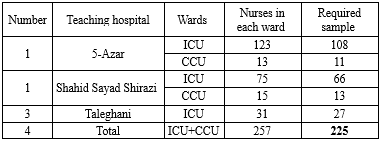
This cross-sectional study was conducted in 2024. Based on the findings of Mahmoud Zadeh et al. (2024), the required sample size was calculated as 225 critical care nurses using G*Power software version 3.0.1, with an assumed effect size of 0.15 (11). The study population consisted of nurses in critical care units of teaching hospitals affiliated with Golestan University of Medical Sciences. Stratified random sampling was performed in the ICU and CCU units of 5-Azar, Shahid Sayad Shirazi, and Taleghani hospitals. The sample allocated to each hospital was determined based on the sampling frame in Table 1. To recruit ICU and CCU nurses and achieve the target sample size, a list of eligible nurses who met the inclusion criteria, was first obtained from the nursing administration of each hospital based on national identification numbers. Participants were selected through simple random sampling and enrolled in the study. The inclusion criteria were having at least a bachelor’s degree in nursing, a minimum of 6 months of full-time work experience in a critical care unit, and willingness to participate in the study. The exclusion criteria included the unwillingness to continue participating in the study for any reason. The data collection tool consisted of two parts, a demographic and professional characteristics questionnaire and the Medication Safety Competence Scale.
Medication errors cause serious complications to healthcare systems worldwide. The most critical aspect of medication errors is their preventability and the potential for serious patient injury. Medication safety is defined as the absence of preventable harm associated with medication use (1). Safe nursing care is a fundamental component of nursing quality (2) and refers to the application of nurses’ knowledge and skills to deliver high-quality care while minimizing the risk of patient harm. In other words, safe nursing care aims to ensure patient safety across all dimensions of care and is considered a key indicator in clinical governance and risk management programs (3). Safe nursing care has also been described as the prevention of harm that may arise from clinical or medical errors (4).
Drug administration constitutes a complex process involving multiple steps, including diagnosis, drug selection, dose calculation, precise preparation by the nurse, patient education, medication infusion, ongoing monitoring and evaluation by physicians and nurses, and accurate documentation (5). Medication administration is one of the core responsibilities of nurses, and the quality and quantity of these activities directly influence patient safety and the overall quality of care (6). In addition, nurses play a pivotal role in medication safety management that extends beyond drug preparation and administration. They coordinate the care process and, due to their continuous interaction with patients, are uniquely positioned to assess patients’ conditions regarding prescribed medications using their knowledge, critical thinking, and clinical reasoning skills (6,7).
Medication safety refers to protecting patients from potential harm associated with medication use. It includes efforts to prevent the causes of medication errors and to identify, manage, and mitigate adverse drug reactions. Medication safety competence refers to the knowledge, attitudes, and skills related to medication safety (8) that nurses apply in clinical practice. This competence includes theoretical and cognitive knowledge, practical skills, and decision-making abilities. Medication safety competence is demonstrated throughout the medication administration process, which includes assessing the patient’s need for medication, evaluating the patient’s clinical condition, preparing the medication, dispensing and administering it, providing patient education effectively, and monitoring and evaluating its effectiveness. It also involves responsibilities related to medication storage, transport, and safe disposal. Medication safety competence is inherently linked to nurses’ professional values, work-related attitudes, and individual patient circumstances (9).
The importance of medication safety competence is particularly pronounced in critical care units (ICUs and CCUs), as patients in these settings receive a higher number of medications than those admitted to general wards and are often exposed to complex therapeutic regimens. In addition, sedation, decreased levels of consciousness, and hemodynamic instability in critically ill patients pose substantial challenges to accurate patient identification, medication administration, and monitoring of adverse drug events (10). Critical care nurses also encounter distinct workplace demands, including high workload, the need for rapid clinical decision-making in emergency situations, responsibility for the care of critically ill patients, frequent exposure to ethical dilemmas, emotional exhaustion, and, in some cases, the responsibility of communicating unfavorable information to patients’ families. These factors collectively impose considerable psychological and cognitive burden on nurses and may increase vulnerability to medication errors (10).
Consequently, ensuring an adequate level of medication safety competence among critical care nurses is essential. Although patient safety competence has been investigated in various nursing populations, there is a limited evidence addressing medication safety competence among nurses working in high-risk clinical environments. Moreover, nurses in critical care units differ fundamentally from those in general wards in terms of patient acuity and hemodynamic instability, medication complexity, time pressure, and clinical responsibilities. Therefore, findings derived from non-critical care settings may not be directly transferable to critical care environments. For this reason, the present study focused exclusively on critical care nurses to provide a more accurate and context-specific understanding of medication safety competence and its associated factors in high-risk settings. Accordingly, this study aimed to determine the relationship between medication safety competence and selected demographic and professional characteristics among critical care nurses working in teaching hospitals affiliated with Golestan University of Medical Sciences.
Methods
This cross-sectional study was conducted in 2024. Based on the findings of Mahmoud Zadeh et al. (2024), the required sample size was calculated as 225 critical care nurses using G*Power software version 3.0.1, with an assumed effect size of 0.15 (11). The study population consisted of nurses in critical care units of teaching hospitals affiliated with Golestan University of Medical Sciences. Stratified random sampling was performed in the ICU and CCU units of 5-Azar, Shahid Sayad Shirazi, and Taleghani hospitals. The sample allocated to each hospital was determined based on the sampling frame in Table 1. To recruit ICU and CCU nurses and achieve the target sample size, a list of eligible nurses who met the inclusion criteria, was first obtained from the nursing administration of each hospital based on national identification numbers. Participants were selected through simple random sampling and enrolled in the study. The inclusion criteria were having at least a bachelor’s degree in nursing, a minimum of 6 months of full-time work experience in a critical care unit, and willingness to participate in the study. The exclusion criteria included the unwillingness to continue participating in the study for any reason. The data collection tool consisted of two parts, a demographic and professional characteristics questionnaire and the Medication Safety Competence Scale.
|
Table 1. Sample frame
 |
The demographic questionnaire, developed by the research team, included variables such as age, gender, marital status, and education level. Professional characteristics included employment status, clinical nursing experience, critical care nursing experience, and type of shift.
Medication Safety Competence Scale (MSCS)
This scale was developed by Park et al. (2021) in South Korea (12), and translated and psychometrically validated in Persian by Mohammadi et al. in 2023, with an overall Cronbach’s alpha coefficient of 0.96 and 0.77 to 0.91 for its subscales/dimensions (13). The instrument included 36 items across six subscales: patient-centered medication management (9 items), safety problem improvement (8 items), management of affecting factors (6 items), safety risk management (6 items), multidisciplinary collaboration (4 items), and responsibility in the nursing profession (3 items). Each item is scored on a 5-point Likert scale: never (1), rarely (2), sometimes (3), often (4), always (5). Total scores range from 36 to 180, with scores of 36-90 indicating poor medication safety competence, 91-150 indicating a moderate level, and 151-180 indicating a high level. The instrument has established psychometric properties, and its reliability in the Iranian context was confirmed by Mahmoud Zadeh et al. (2024), who reported a Cronbach’s alpha coefficient of 0.81 (11). To facilitate comparison among subscales, the raw mean score for each subscale was divided by the number of items in that subscale.
Data collection
Data collection commenced after obtaining ethical approval from the Ethics Committee of Golestan University of Medical Sciences (IR.GOUMS.REC.1403.230). Eligible nurses were identified and invited to participate in the study. After providing a clear explanation of the study objectives, written informed consent was obtained from all participants. Data were collected using self-administered questionnaires, which were distributed in person by the researcher. Questionnaires were completed individually and collected on the same day to ensure data completeness. Data collection was conducted over a four-month period, from October to January 2024. A total of 225 questionnaires were distributed and completed in full. No participant attrition occurred during the data collection process. The researcher visited the selected units during morning, evening, and night shifts to ensure adequate access to participants across different work schedules.
Data analysis
All completed questionnaires were entered into the statistical analysis. Data were analyzed using SPSS version 26. Descriptive statistics, including mean and standard deviation for quantitative variables and frequency and percentage for qualitative variables, were used. The normality of quantitative variables was assessed using histograms, normal distribution curves, and the Kolmogorov-Smirnov test. The results indicated that the data were not normally distributed (p < 0.05). Therefore, the Mann-Whitney U test and Kruskal-Wallis test were used for bivariate analyses. Stepwise multiple linear regression analysis was then performed to identify demographic and professional predictors of medication safety competence. To investigate the effect of demographic and professional variables on the medication safety competency score, the assumptions of the linear regression model were examined, including normality of the distribution, independence of observations and equal variance. Then multiple linear regression was fitted to the data. The significance level for all tests was set at 0.05.
Results
The mean age of the nurses was 32.26 ± 7.40 years, and the median (Range) was 31 years (22-51). Most participants were female (175, 77.8%). The largest age group consisted of nurses younger than 30 years (110, 48.9%). The majority of them (89.3%) had a bachelor's degree. The other demographic and professional characteristics of the participants are presented in Table 2. The mean ± standard deviation of the total medication safety competence score was 137.51 ± 27.81, and the mean scores of its subscales are shown in Table 3. Among the subscales, safety risk management had the highest mean score (3.90 ± 0.96), whereas multidisciplinary collaboration had the lowest mean score (3.59 ± 1.00).
Among the variables examined, medication safety competence was significantly associated with age (p = 0.043) and clinical nursing experience (p = 0.009).
Among the examined variables, a significant association was found between medication safety competence and both age and clinical nursing experience (p=0.043, p=0.009 respectively). Post hoc analysis revealed a significant difference in mean competence scores for nurses aged 42 years or older compared with other age groups (p < 0.014). Similarly, nurses with more than 20 years of clinical nursing experience had significantly higher competence scores than the other experience groups (p < 0.002).
In the stepwise multiple linear regression analysis, only age (p = 0.027) and clinical nursing experience (p = 0.017) remained in the final model, whereas the other variables were excluded because they were not statistically significant. These results indicate that age and clinical nursing experience are significant predictors of medication safety competence. Specifically, each additional year of age was associated with a 0.55-point increase in medication safety competence score, and each additional year of clinical nursing experience was associated with a 0.63-point increase. The variance inflation factor (VIF) was 1.00, indicating no evidence of multicollinearity among the predictors (Table 4).
|
Table 2. Demographic characteristics of nurses participating in the study (n=225) and the association between demographic characteristics and responses
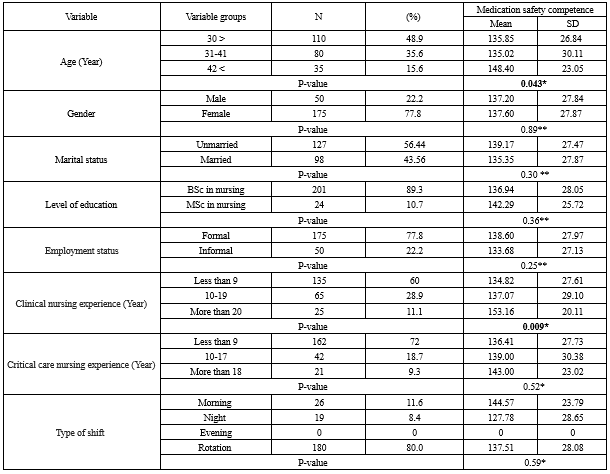 *Kruskal-Wallis test **Mann-Whitney U test. N: Number Table 3. The mean score of the subscales of medication safety competence  1 To enable comparison of the means of different subscales, the raw mean score was divided by the number of items in each subscale SD: Standard Deviation Table 4. Stepwise multiple linear regression analysis of age and clinical nursing experience as predictors of medication safety competence  |
Discussion
The present study was conducted to examine the association between medication safety competence and selected demographic and professional variables among nurses working in critical care units. According to the findings, nurses demonstrated a moderate level of medication safety competence, with only a small proportion exhibiting poor competence. Similar results were reported in studies by Mohebi (2024), Mahmoud Zadeh (2024), Aghabarary (2025), Aydinli (2024), Song and colleagues (2022), where medication safety competence was also found to be moderate (6,11,14-16). In contrast, studies by Mohammadi (2023) and Zhang et al. (2024) reported high levels of medication safety competence (13,17). Because most studies report moderate to high levels of competence, and very few report poor competence, it may be inferred that nurses generally have an awareness of professional responsibility and demonstrate a basic level of medication safety competence (11).
Among the subscales, safety risk management had the highest mean score, whereas multidisciplinary collaboration had the lowest. Safety risk management reflects the ability to respond promptly and report errors during medication safety incidents and adverse drug events. Multidisciplinary collaboration refers to the ability to work cooperatively, communicate effectively, and share decision-making with other healthcare providers throughout the medication-use process (11). In the study by Mohebi et al. (2024), the highest mean score was reported for the subscale “management of influencing factors,” while the lowest was observed for “responsibility in the nursing profession” (14). Song et al. (2022) similarly reported the highest score for “management of influencing factors” and, consistent with the present findings (16). In the study by Zhang et al. (2024), the highest score corresponded to patient-centered medication management, whereas the lowest pertained to safety problem improvement (17). Aghabarary et al. (2025) also found the highest scores for patient-centered medication management and, similar to our results, the lowest for multidisciplinary collaboration (6). Similarly, Kim et al. reported the highest and lowest scores for patient-centered medication management and multidisciplinary collaboration, respectively (18). In studies by Mohammadi (2023) and Aydinli (2024), the highest means were also observed for patient-centered medication management and the lowest for responsibility in the nursing profession (13,15).
Across many studies, patient-centered medication management consistently receives the highest scores among the dimensions of medication safety competence. This subscale reflects the ability to assess the effectiveness of medication education, document care accurately, plan and administer medications, complete dosage procedures correctly, and evaluate patients’ conditions during medication administration, thereby ensuring safe drug delivery (12). However, in the present study, the highest mean score was observed for safety risk management. This contrast may be attributed to positive factors such as the institution’s emphasis on patient safety and a well-established error-reporting culture, or conversely, to challenges like staffing shortages and workload pressures. It may also depend on the type of clinical unit studied or targeted nursing education related to safety risks. Therefore, differences between the present and previous studies likely originate from organizational, educational, and environmental factors. These findings highlight that various aspects of medication safety competence are influenced by the nursing work environment, and that practical priorities shift depending on healthcare system characteristics and management structures.
Furthermore, low scores in multidisciplinary collaboration observed in several studies may be linked to traditional hospital structures, communication barriers between professional groups, and a lack of interpersonal education or teamwork training (10,19). The higher standard deviation observed for this subscale compared with others indicates greater variability in nurses’ experiences and perceptions. These findings suggest that nurses demonstrate a somewhat passive role in collaborative practice with other healthcare team members. Enhancing interpersonal communication and collaboration is essential for strengthening patient safety and improving safe nursing care (18). Effective teamwork requires the ability to anticipate others’ needs, adapt to changing roles, respond to environmental changes, and maintain a common perception of tasks to achieve optimal outcomes (20).
The results also showed that nurses aged over 42 years had significantly higher medication safety competence scores compared with younger age groups. No significant difference was observed between the two younger groups, suggesting that age becomes influential when nurses enter their early forties. This likely reflects the accumulation of substantial clinical experience and exposure to complex care situations, which ultimately enhances medication safety competence. Similarly, nurses with more than 20 years of work experience had significantly higher competence levels than those with less than 9 years or 10–19 years of experience. This finding indicates that substantial improvements in medication safety competence typically emerge during the third decade of professional practice. Consistent with the present results, studies by Luokkamäki (2021), Jung (2025), and Mahmoud Zadeh et al. (2024) also demonstrated that higher age and longer clinical experience contribute to improved decision-making, clinical reasoning and enhanced medication safety competence (1,11,21).
Conclusion
The present study highlights moderate medication safety competence among nurses. Although a small proportion of nurses demonstrated low competence, the overall mean score suggests that there remains considerable room for improvement. Accordingly, the moderate level observed in this study warrants attention from nursing administrators and healthcare policymakers.
The highest score in safety risk management may reflects the institution’s emphasis on patient safety culture, error reporting, risk management training, and accreditation requirements-particularly in critical care units, where the consequences of medication errors are more severe. Conversely, multidisciplinary collaboration received the lowest score. This weakness is important, as insufficient collaboration is a recognized contributor to medication errors in critical care settings, emphasizing the need for teamwork educational interventions and strengthened nursing involvement in medication-related decision-making.
Only age and clinical nursing experience were significant predictors of medication safety competence. Meaningful improvement in competence appeared primarily after the fourth decade of life and beyond 20 years of clinical experience, highlighting the importance of practical exposure to complex clinical situations, crisis management, and the progressive recognition of error patterns. These findings also underscore the value of experienced nurses in critical care units.
Overall, this study emphasizes the need for organizational investment in enhancing medication safety skills, particularly among younger and less experienced nurses. Future research is recommended to explore strategies for strengthening multidisciplinary collaboration and reducing communication barriers among healthcare providers.
Acknowledgement
This article is part of a master’s thesis in critical care nursing supported by Golestan University of Medical Sciences. The authors express their sincere gratitude to the university’s Vice-Chancellery for Research and Technology and to the dedicated and compassionate nurses who generously assisted despite their workloads.
Funding sources
The Research and Technology Deputy of Golestan University of Medical Sciences financially supported the present study.
Ethical statement
All ethical requirements were observed throughout the study. This study was approved by the Ethics Committee under the code IR.GOUMS.REC.1403/230. Authorization was obtained from the university and participating hospitals; written informed consent was secured from all nurses; confidentiality and anonymity of responses were ensured; and participants were free to enter or withdraw from the study at any stage. The study presented no more than minimal risk of harm to subjects and involved no procedures for which written consent is required outside the research context. The cross-sectional design, reliance on self-reported data and restriction of the sample to critical care nurses in teaching hospitals limit generalizability of the finding.
Conflicts of interest
The authors declare no conflict of interest.
Author contributions
SK and KY Conceptualized the study design, SK and FJ Writing-Review and Editing, Writing-Original draft, Validation, Supervision, Project administration, Methodology, Data curation, and Conceptualization, FJ and SG Analyzed and Interpreted the data, SK and FJ Drafted the manuscript. All authors read the revised manuscript and approved the final version.
Data availability statement
The data support the findings of present study are available from the corresponding author upon reasonable request.
Article Type: Research |
Subject:
Nursing
Received: 2025/10/1 | Accepted: 2025/11/30 | Published: 2025/12/30 | ePublished: 2025/12/30
Received: 2025/10/1 | Accepted: 2025/11/30 | Published: 2025/12/30 | ePublished: 2025/12/30
References
1. Jung S, Park J. Educational needs for medication safety competence among nurses by clinical ladder stage. PLoS One. 2025;20(4):e0319483. [View at Publisher] [DOI] [PMID] [Google Scholar]
2. Austin JM, D'Andrea G, Birkmeyer JD, Leape LL, Milstein A, Pronovost PJ, et al. Safety in numbers: the development of Leapfrog's composite patient safety score for U.S. hospitals. Journal of Patient Safety. 2014;10(1):64-71. [View at Publisher] [DOI] [PMID] [Google Scholar]
3. Rashvand F, Ebadi A, Vaismoradi M, Salsali M, Yekaninejad MS, Griffiths P, et al. The assessment of safe nursing care: development and psychometric evaluation. J Nurs Manag. 2017;25(1):22-36. [View at Publisher] [DOI] [PMID] [Google Scholar]
4. Tourani S, Khodayari Zarnaq R, Arabloo J, Esmaili A, Taghizadeh S, Khosravizadeh O. A Survey on Patient Safety Using the Farsi Version of the Safety Attitudes Questionnaire in Iran. Payavard Salamat. 2016;10(1):82-92. [View at Publisher] [Google Scholar]
5. Llapa-Rodriguez EO, Silva LSL, Menezes MO, Oliveira JKA, Currie LM. Safe patient care in the preparation and administration of medicines. Rev Gaucha Enferm. 2017;38(4):e2017-29. [View at Publisher] [DOI] [PMID] [Google Scholar]
6. Aghabarary M, katebi F, M. B. A Survey-Based Study of Medication Safety competence and Its Relationship with Safe Nursing Care among Nurses. SAGE Open Nurs. 2025;11:1-10. [View at Publisher] [DOI] [PMID] [Google Scholar]
7. Smeulers M, Onderwater AT, van Zwieten MC, Vermeulen H. Nurses' experiences and perspectives on medication safety practices: an explorative qualitative study. J Nurs Manag. 2014;22(3):276-85. [View at Publisher] [DOI] [PMID] [Google Scholar]
8. Rodrigues M, Fernández-Macías E, Sostero M. A unified conceptual framework of tasks, skills and competences. JRC Working Papers Series on Labour, education and Technology; 2021. [View at Publisher] [Google Scholar]
9. Fusco LA, Alfes CM, Weaver A, Zimmermann E. Medication Safety Competence of Undergraduate Nursing Students. Clinical Simulation in Nursing. 2021;52:1-7. [View at Publisher] [DOI] [Google Scholar]
10. Farzi S, Irajpour A, Saghaei M, Ravaghi H. Causes of medication errors in intensive care units from the perspective of healthcare professionals. J Res Pharm Pract. 2017;6(3):158-65. [View at Publisher] [DOI] [PMID] [Google Scholar]
11. Mahmoud Zadeh M, Zia SK, Dadkhah B, Mohamadi MA. Evaluation of the relationship between drugs' safety competence and Medication Administration Error Perceptions in Clinical nurses of Northwest Iran. Research square. 2024:1-13. [View at Publisher] [DOI] [Google Scholar]
12. Park J, Seomun G. Development and Validation of the Medication Safety Competence Scale for Nurses. West J Nurs Res. 2021;43(7):686-97. [View at Publisher] [DOI] [PMID] [Google Scholar]
13. Mohammadi F, Kouhpayeh SA, Bijani M, Farjam M, Faghihi A, Badiyepeymaiejahromi Z. Translation and psychometric assessment of a Persian version of medication safety competence scale (MSCS) for clinical nurses. Sci Rep. 2023;13(1):2247. [View at Publisher] [DOI] [PMID] [Google Scholar]
14. Mohebi Z, Bijani M, Dehghan A. Investigating safe nursing care and medication safety competence in nursing students: a multicenter cross-sectional study in Iran. BMC Nurs. 2024;23(1):13. [View at Publisher] [DOI] [PMID] [Google Scholar]
15. Aydinli A, Cerit K. An analysis of the psychometric properties of the medication safety competence scale in Turkish. BMC Nurs. 2024;23(1):578. [View at Publisher] [DOI] [PMID] [Google Scholar]
16. Song G, Kim O. Influences of Organizational Communication Satisfaction and Safety Climate on Medication Safety Competence in Hospital Nurse. J Korean Acad Nurs Adm. 2022;28(3):297-306. [View at Publisher] [DOI] [Google Scholar]
17. Zhang P, Xu R, Cao S, Mo L, Liu Y, Gao C, et al. Relationship between critical thinking ability and medication safety competence among clinical nurses: A multicenter cross-sectional study. J Clin Nurs. 2025;34(6):2107-16. [View at Publisher] [DOI] [PMID] [Google Scholar]
18. Kim G-H, Lee H-J. Factors Influencing Clinical Nurses' Medication Safety Competence. J Korean Acad Fundam Nurs. 2022;29(2):237-47. [View at Publisher] [DOI] [Google Scholar]
19. Dush J, Schmuhl KK, Downing MN, Summers KE, Lovatt BS, Miracle TL, et al. Addressing Medication Misuse in Nursing Education: An Interdisciplinary Collaboration. J Nurs Educ. 2025;64(9):128 -31. [View at Publisher] [DOI] [PMID] [Google Scholar]
20. Hwang JI, Ahn J. Teamwork and clinical error reporting among nurses in Korean hospitals. Asian Nurs Res (Korean Soc Nurs Sci). 2015;9(1):14-20. [View at Publisher] [DOI] [PMID] [Google Scholar]
21. Luokkamäki S, Härkänen M, Saano S, Vehviläinen‐Julkunen K. Registered Nurses' medication administration skills: a systematic review. Scand J Caring Sci. 2021;35(1):37-54. [View at Publisher] [DOI] [PMID] [Google Scholar]
Send email to the article author
| Rights and permissions | |
 |
This work is licensed under a Creative Commons Attribution-NonCommercial 4.0 International License. |

This work is licensed under a Creative Commons Attribution-NonCommercial 4.0 International (CC BY-NC 4.0).
